
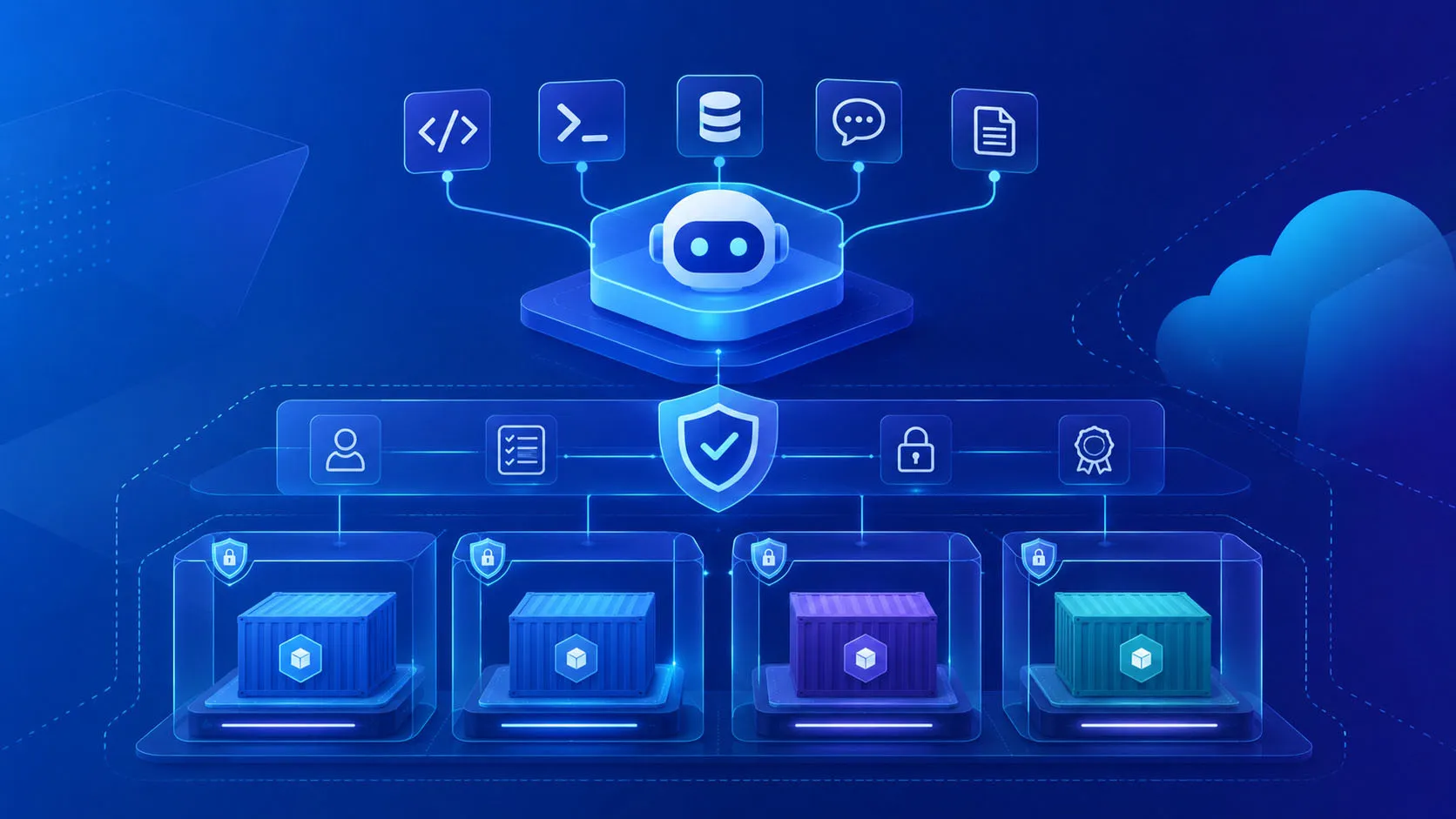
Artificial intelligence is already transforming roles and processes within companies, creating a new class of organizations. According to Microsoft, the future belongs to companies that transform AI into a controlled and continuously evolving system. The tech giant is providing them with the tools to realize this vision in the form of a comprehensive agent-based platform. This solution puts developers at the center, offering them complete flexibility and freedom of choice at every level of the architecture.
Artificial intelligence has long since ceased to be limited to simple chatbots. Today, the key to transformation lies in autonomous teams of agents capable of carrying out long-term tasks in areas such as programming, finance, HR, and customer support. However, a language model alone is not enough to safely deploy such tools in production. A complete infrastructure is essential: identity management, business context, robust security policies, and constant human oversight.
Keys to Transformation in the Era of Agent-Based AI
To meet the demands of modern businesses, an AI agent management platform must support real-world business processes and reflect organizational complexity. Microsoft bases its new solution on three key principles:
- An integrated system and support for multiple models: Companies cannot build AI strategies from disparate components. Combining inconsistent tools slows down work and creates risks. The processes of creating, deploying, and monitoring agents must take place within a single system. For this reason, Microsoft integrates Azure, GitHub, Microsoft IQ, Fabric, Foundry, Windows, Microsoft Security, and Microsoft 365. Users gain the ability to choose models—ranging from Microsoft solutions to partner models and open-source versions—while balancing quality, speed, and cost.
- Security and corporate governance from the ground up: management and control are built into the system’s architecture, from the development phase all the way through to production. Thanks to the expansion of tools such as Entra, Purview, Defender, and Agent 365 , control mechanisms become native and support the organization’s ambitions without compromising data control.
- Continuous improvement and feedback loops: AI systems cannot be static. Agents’ actions, their results, and feedback from humans feed back into the system, allowing models and processes to evolve safely under human supervision. In this way, the tools become increasingly specialized, which translates into a higher return on investment.
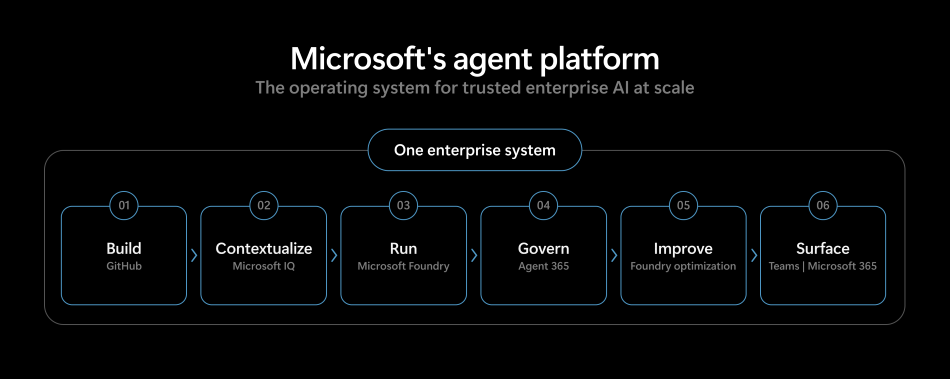
Step 1: Building agents in the GitHub Copilot environment
The process of creating AI agents begins right where developers do their day-to-day work. GitHub collects dependencies, application context, and code repositories. The creation of agents should follow the same process as for traditional production software.
Developers can use GitHub Copilot to speed up their work by combining code repositories, tasks, and agents’ specific skills. In the new, dedicated application, developers manage the full agent lifecycle: from source code, through testing and deployment, to behavior monitoring (based on evaluation processes and data stream tracking).
Step 2: Contextualizing Data with Microsoft IQ
Code alone isn't enough to make an agent useful. The tool must understand the specifics of the business in question: customers, products, contracts, and internal procedures. Without being properly grounded in the company’s reality, even the most advanced model will be based solely on guesswork—and that’s exactly what we want to avoid.
The Microsoft IQ platform is responsible for grounding agents in the company’s data. It connects to data from Microsoft 365, sales systems, and knowledge bases. The new solution Web IQ also allows users to retrieve up-to-date data from the web. Microsoft IQ organizes and secures these resources, eliminating information noise and minimizing the risk of AI hallucinations—that is, the problem of generating non-existent content.
The next step is Frontier Tuning technology, which allows you to modify the behavior of models based on your company’s actual processes. Microsoft is introducing seven new MAI models (covering image, speech, transcription, coding, and reasoning) that learn through specialized reinforcement learning environments (so-called “AI training gyms”). Importantly, all modified and fine-tuned models remain within the customer’s secure environment, and the intellectual property developed does not leave the organization.
Step 3: A Stable Runtime Environment in Microsoft Foundry
After the build and context configuration phases, the agents must be deployed to the production environment. However, autonomous systems differ from traditional applications. They require continuous reasoning, coordination of actions with other agents, and invocation of external tools. The Foundry runtime layer addresses these needs.
Microsoft Foundry provides access to a broad model repository and optimizes costs using an intelligent query router. Through its partnership with Fireworks AI, Microsoft’s agent-based platform offers fast and efficient inference for open models. The system supports not only tools built within the Microsoft ecosystem, but also agents built using LangGraph, the Claude Agent SDK, or proprietary solutions.
Integration with the MCP protocol, APIs, and connectors allows agents to securely interact with external systems. The entire system is secured by a strict security policy architecture that controls every call and operation.
Step 4: Scalable Management with Microsoft Agent 365
As individual teams within corporate structures begin to develop their own tools, the number of such tools quickly grows to the hundreds or thousands. This creates a risk of chaos: uncontrolled access to data or duplication of the same functionalities across different departments.
The solution to these challenges is a product called Agent 365, which integrates with Entra, Purview, and Defender (enhanced with the MDASH cybersecurity architecture). It allows for the consolidation of all digital personnel into a single directory. The IT department gains full visibility into who has deployed a given agent, what resources the agent has access to, how it behaves, and what costs it generates. This enables centralized enforcement of security policies and immediate response to anomalies.
Step 5: Continuous Optimization and the Learning Loop
AI agents in an enterprise cannot remain a static product. Every operation performed generates unique signals, action trajectories, and user evaluations. The system collects this data, analyzes it, and implements improvements as part of a continuous cycle of observation, evaluation, refinement, and secure deployment. Initial improvements typically focus on the prompts, skills, or knowledge base of the agent itself.
Over time, the collected patterns enable better routing to models, advanced training and fine-tuning, and optimization through reinforcement learning. The entire process takes place in a controlled manner under human supervision, which ensures that the systems’ growing autonomy does not spiral out of the company’s control.
Step 6: Workplace Integration and Azure Infrastructure
The technology will only be effective if it reaches employees directly. Agents are integrated directly with Microsoft Teams, Microsoft 365, and third-party business applications. Thanks to built-in authentication mechanisms, they inherit the same trust models that are already in place within the organization.
Users can develop and run these solutions on Windows, using either cloud or on-premises models, while maintaining security through sandbox mode. When powerful computing power, global infrastructure, or data sovereignty are required, the platform scales using the Azure cloud.
As an ecosystem designed in this way operates, its value multiplies. Organizations can operate more quickly by eliminating downtime and communication bottlenecks, while employees gain the freedom to be creative and coordinate strategic activities. Microsoft’s integrated platform thus becomes the new operating system for enterprise-scale artificial intelligence.
Source: Microsoft, own elaboration