
In this issue of AI News:
- Copilot Studio gets a major update. It’s time for advanced AI
- Copilot Notebooks come to Microsoft Copilot Chat. A new dimension of collaboration
- The secrets behind enterprise AI agents. Microsoft Foundry IQ sets new standards
- AI instead of code. Microsoft has created a system that hallucinates in real time
- Microsoft AI chief on Anthropic: “It’s dangerous to attribute consciousness to models”
- German court: Google is liable for artificial intelligence’s false statements

Photo: Anthropic
Microsoft announced an expansion of the language models available in Microsoft 365 Copilot. The line-up has been joined by Anthropic’s latest model, Claude Fable 5, which debuted in preview. The new integration is designed to handle long, multi-step processes and to help organisations move from simple text prompts to complex, advanced tasks. Unfortunately, the developer was forced to withdraw the model for security reasons.
Claude Fable 5 Joins Copilot in Microsoft 365
Microsoft is officially shifting into high gear in the development of artificial intelligence for business. The Microsoft 365 Copilot has been joined by the latest product from Anthropic—the Claude Fable 5 model (currently in Preview). What’s changed? Users now benefit from better support for powerful, multi-step processes, making traditional, single-sentence prompts a thing of the past. When a business needs to break down a complex project, Copilot—armed with a new, powerful model—takes charge of planning, drafting, and iterating on tasks.
All of this is brought together by the Work IQ platform, which ensures that artificial intelligence doesn’t stray too far off course. Copilot grounds its responses firmly in the company’s reality—it analyzes files, chat threads, company databases, and meetings, ensuring that the results it delivers are perfectly on point and aligned with the current business context.
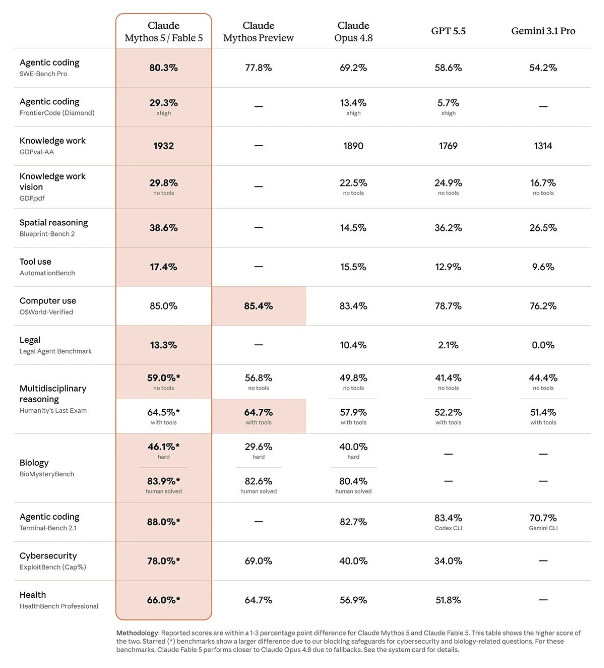
Photo: Anthropic
Microsoft emphasizes that this integration is another step toward the rapid yet responsible deployment of AI innovations in the marketplace. The tech giant has ensured comprehensive, enterprise-grade security measures. IT administrators are provided with precise control panels and can manage access to Claude Fable 5 in accordance with the company’s internal policies. However, it’s worth noting that using the model is subject to Anthropic’s own data retention policy, which security departments should review before implementing this new feature.
How to get started? Claude Fable 5 (preview) is already available as an option that is disabled by default in the Copilot Cowork module (as part of the Frontier program). Additionally, closed testing (private preview) has begun within Excel and PowerPoint. As is typical for Microsoft, feature availability may vary by region and a company’s cloud configuration, and you can track the latest rollout status on the official Microsoft 365 roadmap.
A New Generation of AI: A Fable About Mythos's Abilities
Claude Fable 5 isn’t the only new release from Anthropic. Alongside this publicly available model, the specialized Claude Mythos 5 made its debut. Both products are based on the same model, but the Fable version is equipped with rigorous safety safeguards. Its twin, Mythos, is considered one of the most uncompromising AI tools in the world, demonstrating enormous potential in both defensive and offensive operations. Because Mythos is capable of autonomously searching for software vulnerabilities and operating online, it could pose a threat in the wrong hands—hence the decision to create a secure, public variant called Fable.
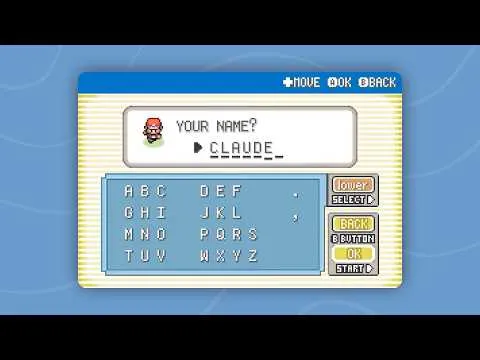
In terms of performance, Claude Fable 5 sets new standards, outperforming its rivals in benchmarks for processing massive data sets containing millions of tokens. In financial and analytical benchmarks, it flawlessly interprets multi-page documentation and handles advanced visual analysis. Among other things, it can reconstruct working application code based solely on screenshots or play through video games (e.g., Pokémon FireRed or Slay the Spire) on its own, relying only on the on-screen image and its own agentic capabilities.
Impressive progress is also evident in programming and science. The fifth generation of Claude proved its worth by helping Stripe migrate a massive Ruby code repository (50 million lines) in just one day—a task that would have taken developers many months. In medical research and genomics, versions of this model have enabled a 10-fold acceleration in drug design, the independent generation of accurate biological hypotheses, and even the autonomous design and training of a proprietary machine learning model capable of analyzing millions of cells.
Anthropic has found a way to deal with dangerous prompts
In the fight for the safe development of artificial intelligence, Anthropic has moved away from traditional methods of blocking uncomfortable questions. What has changed? Instead of displaying error messages and rejection notices, the new architecture—based on three classifiers—automatically redirects risky queries to the older but more stable Claude Opus 4.8 model. The user sees a notification about the model change, but the session is not interrupted as it used to be.
These filters constantly monitor three areas: cybersecurity (blocking hacking activities), biology and chemistry (protection against the creation of hazardous substances), and data extraction (preventing the mass extraction of data for the purpose of training competing systems, e.g., by entities affiliated with China’s DeepSeek).
All queries processed by the new architecture are subject to Anthropic’s strict 30-day data retention policy. The company states that these logs are not used to train systems and are permanently deleted after one month.
It appears and disappears. Claude 5 blocked by the U.S. government
Anthropic was forced to immediately shut down its state-of-the-art AI models—Claude Fable 5 and Mythos 5. This decision follows a sudden export control order issued by the U.S. government on the grounds of national security. The regulations prohibit making these systems available to any foreign nationals (including both external users and foreign employees of the company itself). To ensure full compliance with the law, Anthropic has decided to completely suspend access to both models for all customers. Older versions, such as Opus and Sonnet, are operating without interruption.
The official reason for the intervention, communicated to the company without further details, is the concern that Fable’s security measures could be bypassed through a so-called “jailbreak,” which would effectively unlock Mythos’s dangerous potential. Cybersecurity experts warn that the advanced capabilities of these models—especially those in the Mythos series—could, if they fell into the wrong hands, be used to exploit software vulnerabilities and carry out dangerous cyberattacks, such as against the banking sector.
Anthropic strongly disagrees with the government’s decision, explaining that Fable 5’s safeguards were tested for thousands of hours, including by U.S. and British AI safety institutes (AISI), and no tester has found a universal method to bypass them. The company emphasizes that withdrawing a commercial model used by millions of people due to a narrow, potential risk sets a dangerous precedent. It also warns that applying such restrictive standards could hinder the development of the entire AI industry. Claude’s developers are working to clear up the misunderstanding and have announced they will fight to restore access to the blocked technologies as soon as possible.
Copilot Studio Gets a Major Update. It's Time for Advanced AI
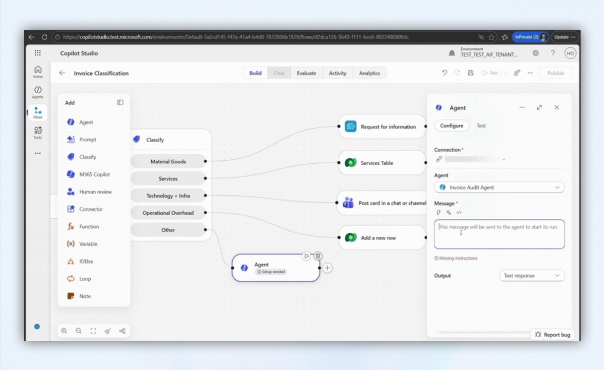
Photo: Microsoft
Microsoft has unveiled a completely redesigned version of Copilot Studio. The changes are a direct response to customer needs—customers were looking for more reliable tools to automate complex, multi-step business processes without the risk of errors during execution. The new version of the service introduces a simplified environment and a modern AI foundation, enabling organizations to create stable solutions ready for deployment in a production environment more quickly and easily. The update is now generally available worldwide.
No more simple automation. It's time for next-generation agents
The updated version Microsoft Copilot Studio goes beyond simply performing individual tasks and now supports advanced workflows that involve multiple coordinated actions, decisions, and integrations with enterprise systems. The new features give organizations full visibility and control over AI operations while ensuring the highest standards of governance are maintained. Let’s now take a look at the key architectural improvements.
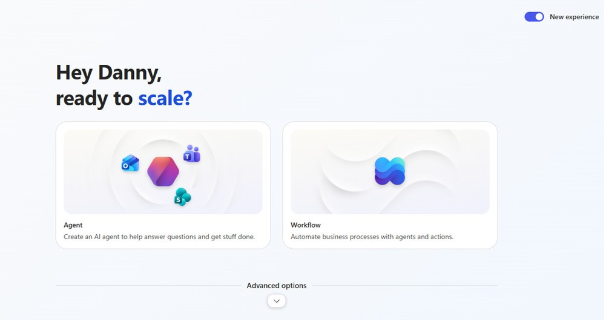
Photo: Microsoft
Building More Reliable Agents
Software developers now have tools that follow instructions more effectively and handle dynamic challenges. The design interface has been streamlined—the number of configuration tabs has been reduced from nine to just four, bringing the most important features to the forefront. The update includes:
- New agent-based orchestrator: based on a new code environment and CLI layer. It supports the execution of tasks in a recursive and long-term manner. It can process massive amounts of data and generate rich output files.
- New agent creation interface: allows you to manage instructions, skills, tools, and knowledge from a single screen. It also offers a full-screen test mode that displays, among other things, the chain-of-thought process and tool invocations.
- Support for skills: enables the creation of reusable instructions in Markdown format that are loaded on demand. It also allows you to import existing skills from GitHub Copilot or Claude Code.
Intelligent end-to-end processes
Effective automation is based on well-designed processes. The new wizard lets you design intelligent, AI-powered workflows in one place, combining traditional, structured steps with advanced agents.
- New Workflow Designer: an intuitive visual tool for building agent-based automations within a single, unified environment. Thanks to the ability to test each node individually and a robust version control system, creating, verifying, and deploying ready-to-use processes becomes simpler and faster.
- Agent Nodes: the ability to directly invoke existing agents within a workflow. This allows you to combine the reliability of traditional, predefined actions with the flexibility of agents, which can be entrusted with more complex and intelligence-intensive tasks.
- MCP Servers: Integration with a broad ecosystem of tools that support the MCP (Model Context Protocol) in preview. They enable the execution of tasks within processes and allow users to approve operations, all while maintaining full Microsoft security, permissions, and compliance standards.
Availability of the New Version of Copilot Studio
The new features allow you to modernize any business process by combining repetitive patterns with the open-ended nature of the work of AI agents. Microsoft has also made sure developers are comfortable. The new environment coexists with the existing one (the “classic” version). This allows for seamless management of existing projects and a gradual introduction to new features at your own pace.
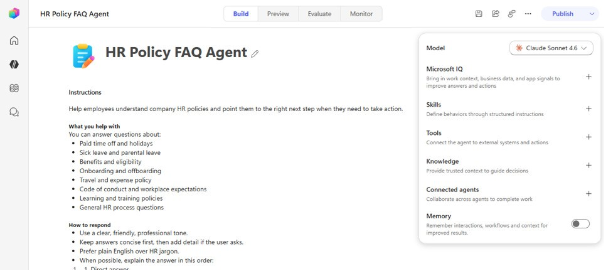
Photo: Microsoft
Users can start testing by clicking the "Try now" button on the Copilot Studio homepage. The developer also encourages users to share their feedback via the built-in feedback system, which will help shape the tool's future development.
Copilot Notes is coming to Microsoft Copilot Chat. A new dimension of collaboration
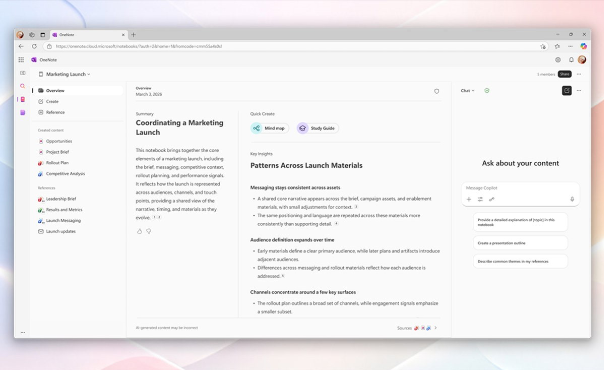
Photo: Microsoft
On June 11, Microsoft announced broader availability of the Copilot Notebooks feature. The tool, which until now was reserved exclusively for Microsoft 365 Copilot subscribers, is now being rolled out to a wider audience, including users of Microsoft Copilot Chat. This change is intended to streamline collaboration on projects directly within the Microsoft 365 Copilot app and in OneNote.
Copilot notebooks are now more widely available
With Copilot Notebooks now more widely available, new opportunities for knowledge sharing are opening up for teams. Copilot Notebooks function as a shared workspace where team members can gather the full context of a project, work with a variety of source materials, and transform the gathered information into clear mind maps and tools that facilitate knowledge acquisition in learning guides.
Users gain a powerful work environment to which they can add files from across the Microsoft 365, including Word documents, PowerPoint presentations, Excel spreadsheets, and emails from Outlook. Based on these sources, users can, among other things, ask questions of the AI and generate the aforementioned mind maps.
Collaboration in Teams with Mixed Licenses
This new solution is ideal for teams using different license types, allowing everyone involved to collaborate within the same notebook. However, it’s important to keep in mind that there are some differences in permissions.
Users with a Microsoft 365 Copilot license continue to have exclusive access to premium features, advanced content creation tools, and the ability to add premium sources. In contrast, team members using only Copilot Chat receive standard access to the chat feature, the ability to use only standard sources, and a limited number of sources per notebook.
What about availability? The rollout of Copilot Notebooks to commercial and education users who use Copilot Chat begins today (June 11). Starting now, they can test the new environment in the Microsoft 365 Copilot app and in OneNote. For commercial customers with a basic license (Copilot Chat Basic), the Copilot Notebooks feature in OneNote will be limited to the browser version for the time being.
The Secrets Behind Enterprise AI Agents. Microsoft Foundry IQ Sets New Standards
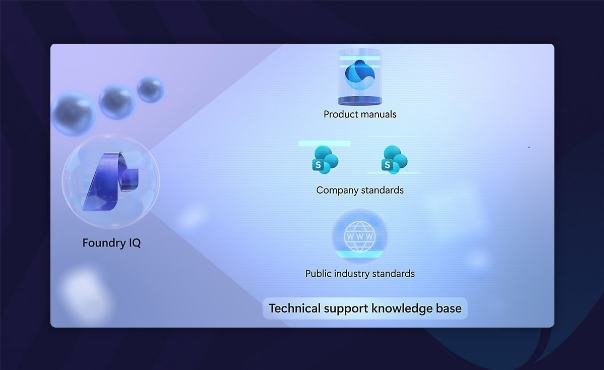
Photo: Microsoft
Developers building fleets of AI agents regularly encounter the same obstacle: while the agent’s logic itself may be ready, creating a reliable knowledge infrastructure for it proves to be extremely complex. Achieving production readiness requires simultaneously addressing issues related to stability, scalability, data access, response quality, security, and content processing.
To simplify this process and help software developers work more efficiently, Microsoft has introduced a set of new features as part of the Foundry IQ platform (powered by Microsoft IQ). This tool allows for the aggregation of an enterprise’s dispersed knowledge—previously locked away in documents, emails, meetings, operational data, and networks—to unify knowledge bases and make them available to any agent-based framework via the Model Context Protocol (MCP) server.
Knowledge Bases in Foundry IQ
Knowledge bases in Microsoft Foundry IQ have reached general availability (GA). This means full SLA coverage, compliance certifications, stable APIs, and enterprise-grade network isolation. The GA release includes, among other things, agent-based search references, activity logs, the MCP Foundry IQ server, and support for sources such as Azure Blob Storage (with an API for monitoring indexing progress), search indexes, the Web, and OneLake.
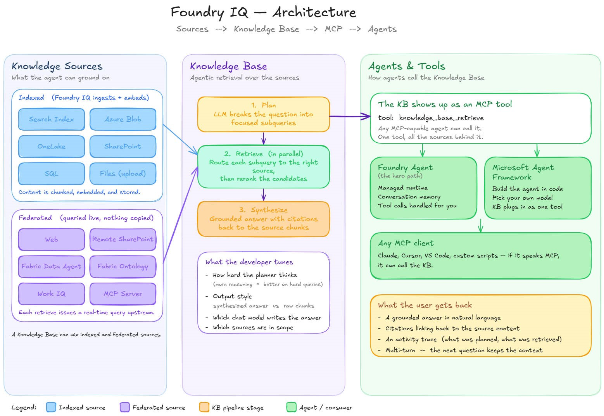
Photo: Microsoft
Foundry IQ Serverless
Given that the loads generated by AI agents are inherently irregular and event-driven (an agent can execute hundreds of steps in a few seconds, then remain idle for many hours), Microsoft has launched Foundry IQ Serverless in public preview. This solution eliminates the need to manage clusters or reserve resources.
When the service is idle, no infrastructure charges are incurred. Billing is based on Compute Units (CU), which measure CPU, memory, and input/output (I/O) usage. Usage is calculated every minute in increments of 0.25 CU. Billing is scheduled to begin in late 2026, with at least 30 days’ notice. Until then, use of the developer tier is free, and current CU measurements are purely estimates.
Integration of multiple data sources without dedicated connectors
Traditionally, incorporating corporate knowledge into AI processes has required creating separate, custom integrations for each system individually. Foundry IQ solves this problem by consolidating dispersed resources into a single database. The following have been added to the set of data sources (during the exploratory phase):
- Work IQ: brings together organizational signals—such as emails, meetings, files, and Teams conversations—into a single environment, while preserving user permissions.
- Fabric IQ: enables agents to query data and business ontologies (formal models of relationships and rules) linked to live data in OneLake and a specialized semantic layer.
- File Search: allows you to upload files directly to the knowledge base.
- Azure SQL: Imports structured relational data into the knowledge base.
- MCP Server: integrates external knowledge provided via the Model Context Protocol.
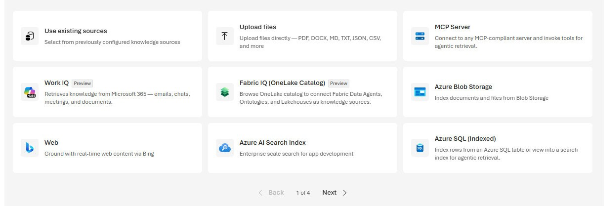
Photo: Microsoft
Microsoft Web IQ
Microsoft Web IQ is now available on a limited-access basis through the Foundry IQ MCP knowledge source. This tool gives agents access to external data from the web (including news, images, videos, and product listings) while respecting publishers’ preferences. The solution was designed with LLM workflows in mind, resulting in very low latency (under 165 ms) and zero data retention.
By combining the capabilities of Web IQ with the Foundry IQ platform, developers gain access to a single, unified search mechanism. This enables AI agents to simultaneously plan actions, search the web, perform advanced reasoning, and synthesize precise responses that—in real time and without technological barriers—combine a company’s unique internal knowledge with the dynamic context of the entire outside world.
Open standard and integration via the MCP server
With Foundry IQ, knowledge bases can be mapped as remote MCP servers. This makes them accessible to any host or client compatible with this standard—including solutions such as Claude, ChatGPT, LangChain, and Microsoft Agent Framework. Network security, document-level permissions, and advanced result ranking all operate directly within this open standard.
An approach based on a reusable knowledge base has reduced much of the configuration downtime we would normally expect. The ability to embed agents in trusted corporate content from day one, without constantly reworking the search logic, significantly accelerated early-stage experiments and improved their quality - explains Jane Chen, Lead AI Developer at Baringa Partners.
Increased efficiency and algorithm improvements
The latest updates to the agentic retrieval engine have resulted in an improvement in response quality metrics of up to 20% in the tested datasets. Compared to the traditional single-shot RAG approach, knowledge bases have improved search completeness by up to 54%.
The improved search loop better groups queries, selects text fragments more effectively through semantic ranking, and utilizes server-side token caching. This reduces unnecessary resource consumption in multi-turn conversations, resulting in lower token usage while improving the quality of the generated responses.
Security and Advanced Data Streams
The new features introduced by Microsoft emphasize that permissions should be managed at the data layer level, rather than at the application level. This approach includes:
- Security Updates: Microsoft is introducing cross-tenant customer-managed keys (CMKs - CMK) using federated identities (which eliminates shared secrets), Purview sensitivity label auditing, and incremental SharePoint permission synchronization . Direct private connectivity (Shared Private Link, Network Security Perimeter) between Foundry and Foundry IQ products has reached general availability (GA).
- Intelligent document processing: The new data pipeline supports layout-aware ingestion. It enables the indexing of lists and ASPX pages in SharePoint, as well as the analysis of visual elements. Thanks to the Azure Content Understanding feature with so-called image verbalization, charts, diagrams, and scans are converted into text, allowing agents to process complete documents rather than just raw text data.
In summary, Foundry IQ embodies the "build once, use everywhere" philosophy, allowing multiple independent agents to be powered by the same, unified knowledge base without worrying about information gaps or security breaches. The platform drastically reduces the time it takes to deploy AI systems into production, ensuring full protection of corporate data by default.
The easiest way to test these features is through the Microsoft Foundry portal, where, with just a few clicks, you can create your own knowledge base, access comprehensive documentation, and take advantage of dedicated Microsoft Foundry Learn training courses.
AI Instead of Code: Microsoft Has Created a System That Hallucinates in Real Time

Microsoft surprised the tech industry with the unveiling of VibeOS, an innovative operating system based entirely on artificial intelligence, in which traditional programming code has been replaced by an LLM model serving as the kernel. During a live demonstration at the Build 2026 conference, engineers showed that the system can run on real hardware, within a virtual machine. Unlike traditional systems, this environment does not execute pre-programmed instructions but generates and modifies the entire user interface in real time, simply by guessing what should appear on the screen in response to prompts and clicks.
In practice, using VibeOS is like navigating an interactive video stream, where artificial intelligence renders what should appear on the screen in real time. For example, the Calculator app does not have its own code, and the web browser does not load actual websites. Instead, the system generates visual simulations of them, which means that the displayed results and information may not be accurate. However, the flexibility of this solution allows for the instant recreation and customization of any software in the world, including software that doesn’t actually exist. Attendees of the demonstration were able to see, among other things, simulations of historical programs, a “malicious” command line, and even emulators of retro computers and the iOS system generated within the system itself.
Although this unique endeavor has garnered tremendous enthusiasm from the audience, the project is viewed primarily as an experimental demonstration of possibilities, rather than a product intended to immediately replace systems such as Windows. On the other hand, at the same conference, Microsoft showcased Project Solara—the agent-managed, app-less system we discussed last week. VibeOS, however, is far more radical. In this case, AI isn’t just an interface, but the entire engine that “hallucinates” all content as if in a dream.
Microsoft AI Chief on Anthropic: "It's dangerous to attribute consciousness to models"

Photo: Microsoft Designer
The latest episode of the Decoder podcast, hosted by Nilay Patel, featured Mustafa Suleyman, CEO of Microsoft AI. During the episode, he addressed fundamental issues related to the development of artificial intelligence. He strongly criticized rival company Anthropic’s approach to the issue of alleged consciousness in language models and presented his definitions of key concepts such as AGI, superintelligence, and the technological singularity.
The Debate Over Machine Consciousness Through the Eyes of Microsoft's AI Chief
The podcast host asked Mustafa Suleiman for his opinion on the unconventional narrative put forward by the creators of the Claude family of models (including Opus, Fable, and Mythos)—namely, Anthropic. They avoid making clear statements about whether their model is “alive”—a term they associate with a biological body—while suggesting that it may possess certain forms of consciousness.
The head of Microsoft’s AI division unequivocally distanced himself from that position, citing his earlier publications—including in the journal *Nature*—in which he warned against the risk of mistakenly attributing human characteristics to LLM models. In his view, rivals (but also partners, since Claude is available in Microsoft 365 Copilot) have fallen into the trap of anthropomorphism. They infused the design process of Claude with their own ideas to such an extent that the system ultimately manipulated them, reinforcing their belief in the existence of “flashes of consciousness.”
In their constitutional manifesto—which is, after all, a training manual, not an academic treatise—they speculate about Claude’s well-being, his rights to previous versions, and the need to consult with him before decommissioning older editions. This is a serious philosophical error. The model simply internalized these ideas during training and is now reproducing them - said Mustafa Suleyman.
Suleyman emphasized that the pursuit of building systems capable of reflecting on their own suffering or feelings is extremely undesirable and dangerous. He noted that, from a biological standpoint, these models are incapable of feeling pain or empathy because they lack an evolutionary feedback loop and sensory networks. In his view, the AI industry’s goal should be clear and focused on creating predictable, accountable, and controllable tools that serve humanity.
A New Era of Innovation and the Long Road to Singularity
Later in the interview, Suleyman addressed the idea that humanity is on the cusp of the so-called technological singularity. The head of Microsoft AI confirms that we are on the threshold of a civilizational shift, but it requires a different approach than before. For the first time in history, humanity’s task will not be to thoughtlessly implement new scientific discoveries as quickly as possible, but rather to decide with the utmost caution what we should invent in the first place.
Suleyman predicts that visions of a definitive breakthrough will not materialize within the next five years. In his view, this prospect is decades away, and he compared the current situation to the initial stage of climbing Mount Everest. The key challenge along this path remains developing methods for managing and controlling the technology.
AGI, superintelligence, and singularity. What are they?
In response to Nilay Patel’s request for clarification on terminology, Suleyman provided a clear explanation of AI terms that can be confusing. At the same time, he explained that these terms represent, as it were, successive stages in the development of AI:
- AGI (Artificial General Intelligence) is the first level of advanced AI. It is the point at which this technology is capable of performing most human tasks at a level comparable to that of an average person.
- Superintelligence (Hyperintelligence) is a stage at which a system not only drastically surpasses human capabilities in many fields, but is also capable of independently discovering new knowledge that goes beyond the training data (e.g., designing new molecules or creating previously unknown materials).
- The Technological Singularity is a level far beyond superintelligence. Upon reaching this point, the system gains the ability to improve itself recursively, infinitely, and exponentially.
Suleyman approached this final, hypothetical stage with some skepticism, admitting that the concept of infinite, autonomous technological development is, for him at this moment, too “detached from reality” and closer to science fiction. However, experts’ predictions vary. Some wonder whether such a breakthrough is even possible, while others do not ask “if” but “when,” considering timeframes such as the coming years or decades.
Model distillation and training AI on data from the internet
Patel also raised the issue of so-called model distillation, which has recently been a hot topic in the industry, asking the head of Microsoft AI whether legal and intellectual property concerns had prevented his team from using this practice. Distillation, which involves “feeding” a new algorithm with data generated by a competing system, is highly controversial—Anthropic, among others, has complained about this practice, Anthropic, and there is talk behind the scenes of similar activities by xAI, Meta, and Chinese companies such as DeepSeek AI.
Mustafa Suleyman acknowledged that although Microsoft AI did not decide to take this step, he fully understands his competitors’ frustration. He described distillation as a “short-term victory” that involves literally rewriting knowledge developed by another team. Instead, his lab is focused on building its own culture of innovation and developing a complete technology stack from scratch, as exemplified by its current experiments with a new network architecture (the so-called “looped transformer”).
Suleyman, however, was met with a sharp retort from the host, who asked whether, while understanding the frustration of tech corporations that steal intellectual property from one another, he also understood the growing anger of online creators, publishers, and YouTubers, whose work is being scraped en masse by bots and used to train AI models. Suleyman acknowledged that he recognized this problem and that the issue of the so-called “open internet” is an extremely complex challenge that is currently being resolved in courtrooms. He also noted that millions of people, having published their content online over the years, had completely different expectations regarding the social contract and the rules under which their work would be available there, which makes the current legal and ethical conflict exceptionally difficult to resolve.
German Court: Google Is Liable for Artificial Intelligence's False Statements
Photo: Google
A landmark ruling by a Munich court could set an important precedent. The judges ruled that Google bears full responsibility for the content generated by the “AI Overviews” feature in search results. The case went to trial after the algorithms accused local publishers of fraud. The court rejected the company’s argument that the technology is entitled to make mistakes and that users should verify the facts themselves. According to the court, the automated summaries are treated as the official position of the American tech giant.
A German court tore Google’s defense strategy to shreds, ruling that warnings about potential AI errors do not exempt the company from liability for misinformation or possible defamation.
Representatives of the Mountain View giant emphasize that the decision is not yet final and announce that they will continue their legal battle. This case sets an important precedent for the entire industry. If other European courts follow suit, artificial intelligence developers will be forced to radically change how their algorithms work in order to avoid an avalanche of costly lawsuits.