

Source: Microsoft
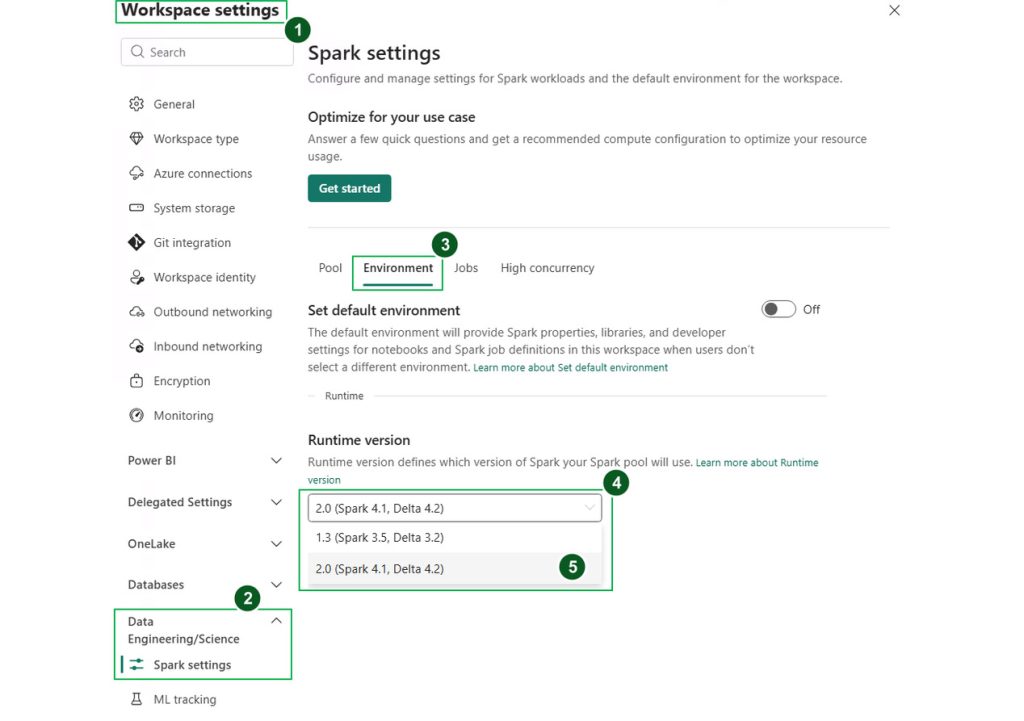
Microsoft Fabric has officially released Runtime 2.0 to General Availability, bringing a modernized execution foundation to Data Engineering and Data Science workloads. Built on Apache Spark 4.1, Delta Lake 4.2, Python 3.13, and Java 21, the new runtime delivers significant performance and security enhancements across large-scale analytics. With Native Execution Engine (NEE) expansions and a planned default transition in late September 2026, enterprise data leaders should begin workload validation now to prepare for seamless migration.
Platform modernization delivers immediate compute and developer efficiency
The jump to Runtime 2.0 replaces aging open-source foundations with a modern stack, including Apache Spark 4.1, Delta Lake 4.2, Python 3.13, Java 21, Scala 2.13, and Azure Linux 3.0. For enterprise data teams, this translates into faster query parsing, better memory management, and access to modern language features without additional operational overhead. The upgrade enables organizations running complex ETL pipelines or large-scale machine learning jobs to execute existing workloads more efficiently while maintaining full platform compatibility.
Native Execution Engine expands automatic performance gains
A core highlight of Runtime 2.0 is the continued evolution of the Native Execution Engine (NEE). By offloading supported Spark SQL and DataFrame operations to a C++-based native vectorization layer, NEE drastically accelerates query execution and reduces node processing time. This capability operates directly under the hood, meaning data engineering teams achieve higher throughput and reduced capacity consumption without rewriting code, refactoring pipelines, or incurring extra licensing fees.
Controlled opt-in strategy ensures smooth enterprise migration
To prevent unexpected disruptions to critical production environments, Microsoft is delaying the automatic default rollout until late September 2026. Workspace administrators and platform owners can opt into Runtime 2.0 immediately at either the workspace or environment level, providing a predictable timeline for testing custom libraries, validating pipeline outputs, and benchmarking cost savings.
Business impact and platform readiness
For data architects and IT leadership, Runtime 2.0 is a high-value upgrade that balances cutting-edge performance with enterprise risk management. The option to test at the environment level allows organizations to isolate validation tasks without risking existing SLA commitments. Early adoption not only lowers overall compute utilization through NEE optimizations, but also ensures your data architecture remains fully aligned with Microsoft's forward-looking roadmap.
Learn more on Microsoft Fabric Updates Blog
Skills for Fabric bridges the gap between AI coding tools and enterprise data architectures
Source: Microsoft
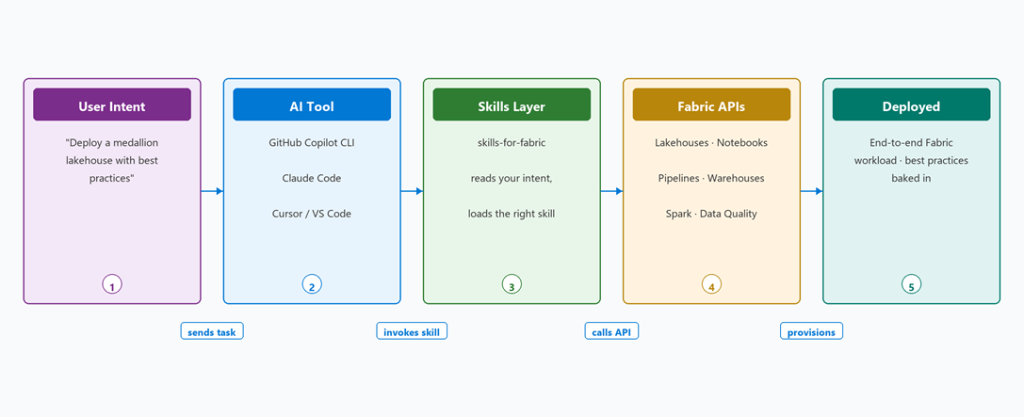
Microsoft has expanded the Skills for Fabric catalogv to include support for SQL database in Fabric, enabling AI coding tools like GitHub Copilot, Claude Code, Cursor, and Windsurf to generate, consume, and operate workload-specific data assets with full context. By replacing broad prompt engineering with targeted, open-source instructions, enterprise development teams can now build end-to-end Fabric solutions - connecting operational databases directly to downstream analytics and AI applications - while keeping compute contexts focused and maintainable.
AI coding agents now understand complete Microsoft Fabric environments
General-purpose coding assistants typically struggle with ecosystem-specific APIs, Microsoft Entra authentication patterns, item discovery, and operational boundaries. Skills for Fabric resolves this by providing lightweight, reusable instruction sets that load on demand. Instead of forcing developers to manually inject system architecture constraints into every prompt, coding agents load specific guidance only when a task requires it.
The addition of the SQL database skill extends this capability beyond simple isolated database management. Agents can now reason across entire Fabric architectures, proposing unified plans that bridge operational tables, lakehouses, data pipelines, semantic models, and reporting layers in a single workflow.
Declarative planning safeguards enterprise governance and data pipelines
For data engineering leads and enterprise architects, the primary value of this update lies in its planning-first design. Before executing commands or deploying schema changes, the AI agent generates a reviewable implementation sequence. This output surfaces underlying assumptions, identifies dependency constraints, and highlights validation checkpoints across three core operational phases:
- Authoring: Generating tables, relationships, indexes, and vector columns for semantic search scenarios.
- Consuming: Discovering schema objects and running SQL queries across connected Fabric experiences.
- Operating: Managing resource connections, executing CLI or API commands, and validating schema modifications before deployment.
This structured workflow ensures that human oversight remains central to the process. Lead engineers and security teams can inspect proposed API interactions and Entra token audiences before changes hit shared workspace environments or production data pipelines.
Faster implementation cycles with built-in architectural guardrails
As enterprise organizations scale their Fabric adoption, maintaining consistent deployment standards across decentralized development teams becomes a significant challenge. By embedding native Fabric practices directly into tools like Visual Studio Code, Cursor, and Claude Code, Skills for Fabric acts as an architectural guardrail. It reduces setup overhead, minimizes configuration drift, and accelerates the transition from conceptual design to production-ready implementation, allowing data teams to deliver connected operational and analytical capabilities with significantly less friction.
Learn more on Microsoft Fabric Updates Blog
Microsoft Fabric accelerates Data Agent setup with AI-guided schema reasoning
Source: Microsoft
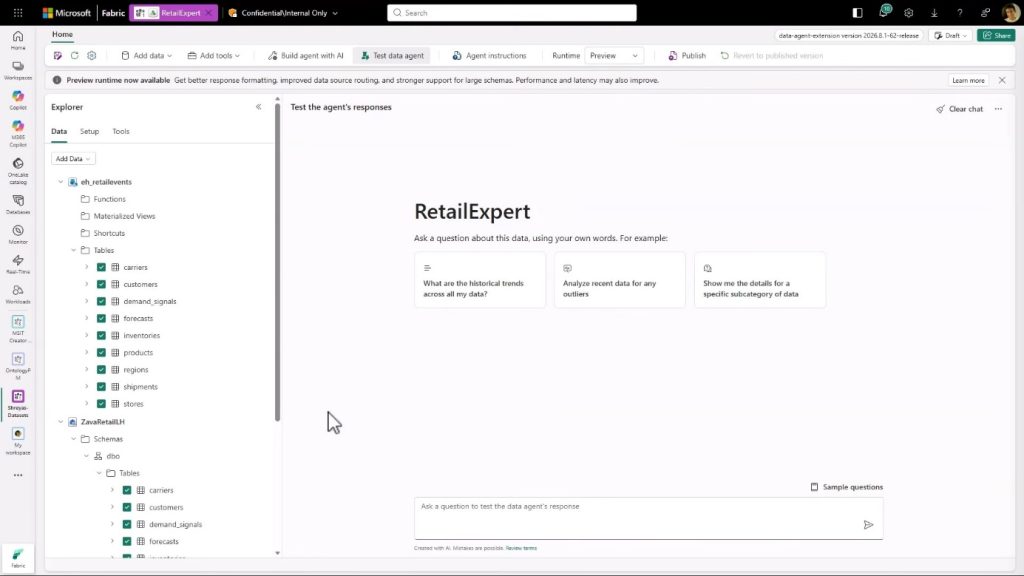
Setting up natural-language data agents in Microsoft Fabric historically meant manual schema exploration, trial-and-error prompt writing, and lengthy validation cycles. Microsoft Fabric now introduces "Build agent with AI" (Preview), an assistant embedded directly in the Data Agent experience that automates complex schema discovery, analyzes past query history, and generates production-ready instructions. For enterprise data teams, this transforms setup times from hours into minutes, drastically lowering the barrier to deploying conversational AI over corporate data stores.
Eliminating the schema bottleneck in enterprise data modeling
Data agents only deliver reliable answer sets when configured with detailed business context, exact join paths, and precise data grain definitions. Previously, data platform teams spent significant effort manually decoding complex relational structures or writing bespoke instructions to prevent hallucinations and bad joins.
The new "Build agent with AI" capability acts as an interactive co-pilot. By connecting directly to SQL analytics endpoints, Warehouses, Mirrored Databases, SQL Databases, and Eventhouses, it automatically summarizes key entities and surfaces common join paths. Architects and engineers can simply prompt the assistant to explore tables or uncover churn patterns, bypassing manual schema discovery entirely.
Leveraging query logs to create reliable configurations
Rather than generating prompt instructions in a vacuum, the feature analyzes patterns from historical queries executed against your systems. It identifies standard aggregation logic, high-frequency filters, and implicit business rules that already exist in your data estate, translating those observations into optimized agent rules and natural-language example queries.
Creators can execute and validate read-only queries against live data within the workspace before committing changes. This iterative, human-in-the-loop workflow ensures that join paths deliver accurate results without risking data modification.
Accelerating time-to-value for enterprise analytics architecture
For Chief Data Officers and Data Platform Managers, this preview directly targets the operational overhead of enterprise AI adoption. By automating the hardest part of agent setup - translating raw physical schemas into semantically sound business models - data teams can scale self-service conversational analytics across business units far faster. The native governance layer ensures control remains firm: the assistant proposes precise configuration updates, but engineers retain full authority to review, adjust, and approve every change before pushing to production.
Learn more on Microsoft Fabric Updates Blog
Microsoft Fabric enables proactive capacity control with real-time monitoring events
Source: Microsoft
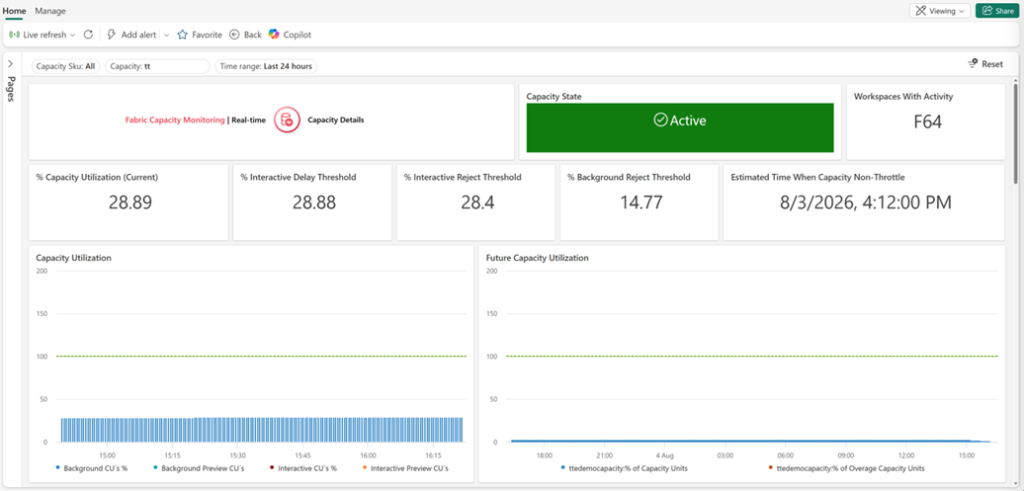
Enterprise data platform leaders can now monitor Fabric capacity health continuously and trigger automated operational workflows as Capacity Overview Events in Real-Time Hub reach General Availability. This release gives administrators instant visibility into compute usage trends and immediate state changes, transforming reactive monitoring into automated governance.
Continuous signals for enterprise capacity health
Until now, capacity monitoring often meant relying on delayed metrics or manual checks. With this update, Fabric emits continuous signals directly into Real-Time Hub via two event streams: Capacity Summary events, sent every 30 seconds to track broad usage trends, and Capacity State events, which fire instantly when a capacity is paused, resumed, or throttled.
By surfacing these metrics as native event streams, Microsoft eliminates the blind spots that typically complicate compute governance in large-scale deployments.
Automated governance meets long-term telemetry retention
The real architectural value lies in pairing these events with Fabric Real-Time Intelligence. Data platform teams can configure automated alerts when utilization hits critical limits, automatically trigger operational workflows to reallocate resources, or stream event logs into Eventhouse.
This allows enterprise teams to store telemetry long-term, feeding historical trend analysis, precise chargeback models, and proactive capacity planning. To accelerate implementation, a community-backed Capacity Events Accelerator provides pre-built templates and dashboards.
Why data leaders should implement real-time capacity events
For CDOs, Data Platform Managers, and enterprise architects, this capability solves a key operational headache: unpredictable compute throttling and unmanaged platform costs. Instead of reacting to user complaints after a heavy workload exhausts compute limits, operations teams can now intervene automatically before performance drops.
This update turns infrastructure signals into actionable governance, making it an essential upgrade for any organization managing multi-tenant or business-critical Fabric environments.
Learn more on Microsoft Fabric Updates Blog
Fabric SQL Audit Logs introduce predicate filtering to cut operational noise
Source: Microsoft
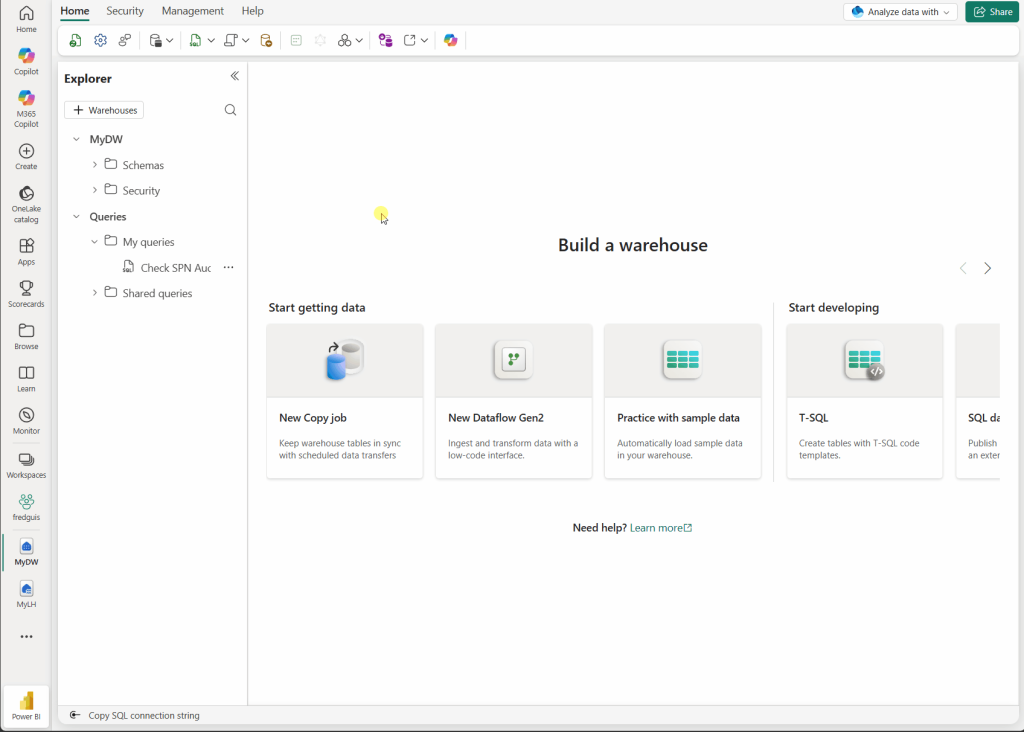
Microsoft Fabric has rolled out identity-based predicate filtering for SQL Audit Logs in Fabric Data Warehouse and SQL Analytics Endpoints. The Generally Available feature allows administrators to exclude specified low-value, high-volume identities-such as automated service principals, validation scripts, and ETL pipelines-directly at the source before events hit storage. By filtering out predictable operational background noise, enterprise security and platform teams gain a much cleaner, higher-value audit stream that speeds up incident investigations and reduces storage overhead.
Dropping predictable service activity at the source
In large data environments, automated identities often generate the vast majority of audit records. These routine background events choke SIEM platforms, inflate storage costs in OneLake, and slow down forensic analysis when an incident occurs. With predicate exclusion filtering, administrators can define a targeted exclusion list of users and service principals.
Activity matching these rules is dropped before the log record is persisted to disk. Because this filtering occurs pre-generation, excluded records cannot be recovered later, turning every exclusion into a formal, deliberate audit policy decision rather than a simple visual UI filter.
Accelerating incident response for enterprise security teams
For Chief Data Officers and Security Operations teams, the primary value lies in drastically reduced investigation times. When evaluating potential security incidents, analysts need to isolate human-driven, interactive, or unusual privilege modifications without sorting through millions of routine metadata syncs.
Filtering out trusted automation identities directly improves the signal-to-noise ratio in log analytics tools and downstream SIEM integrations. Administrators can manage these exclusion lists flexibly, either via the Microsoft Fabric visual administration UI or through APIs to incorporate rules into automated governance pipelines.
Striking the balance between compliance and operational efficiency
For enterprise platforms operating under strict regulatory frameworks, audit policies must remain defensible. While capturing everything seems like the safest default, excessive noise actively hinders compliance readiness.
Organizations should adopt a structured governance process around this feature: exclude only well-understood, narrowly scoped automation identities, conduct periodic reviews of the exclusion matrix, and remove rules immediately if an account's risk profile changes.
Ultimately, filtering known operational background noise lets enterprises cut downstream processing expenses while ensuring their audit trail remains sharp, actionable, and ready for critical forensic work.
Learn more on Microsoft Fabric Updates Blog