

The growing gap between data and decisions
The conclusions presented at FabCon Poland 2025 show how large a gap still exists between the pace of data emergence and an organization's ability to respond to it in real time. Today's organizations operate in a world where data is created in real time, and the market situation can change from day to day. Despite this, many companies still operate on monthly or quarterly reporting cycles. This results in a gap between when a signal occurs and when the organization is able to respond to it. This gap means real costs, lost business opportunities and delayed responses to operational risks.
Across industries, business priorities are remarkably consistent: reducing risk, increasing efficiency, innovating faster and improving customer experience. Data sits at the centre of all of these goals. The problem is that a large portion of organisational data either arrives too late, is fragmented across systems, or is buried in volumes too large for humans to interpret in time.
Why traditional real-time analytics approaches fall short
For years, organisations attempted to address this challenge by assembling complex real-time architectures from multiple tools and platforms. These solutions often combined open-source technologies with cloud services, required highly specialised teams, and were fragile by design. Despite the complexity, many of these architectures still failed to deliver true real-time decision-making. Data could be processed faster, but insight and action remained disconnected. Business users lacked a unified view, and technical teams struggled to maintain consistency, governance and reliability at scale.

What was missing was an integrated approach that connects streaming data, analytics, AI and action within a single platform.
Real-Time Intelligence in Microsoft Fabric: a shift in approach
Real-Time Intelligence in Microsoft Fabric is designed to close the gap between signal and action. Its purpose is not only to process events as they happen, but to enable organisations to observe, analyse and respond within the same operational loop.

Microsoft Fabric provides a unified analytics platform covering data ingestion, analytics, BI and AI. At its core is One Lake, a single, shared data foundation that removes silos and allows all teams to work from a consistent source of truth, governed and secured by default. Real-Time Intelligence builds on this foundation by adding native capabilities for event-driven analytics and AI-supported decision-making.
From events to insight: the Real-Time Intelligence architecture
The Real-Time Intelligence architecture in Microsoft Fabric follows a clear and streamlined flow. Operational systems send events through built-in connectors into Event Stream, which handles real-time ingestion and preprocessing. A key addition introduced during the session is Event Schema Set. It allows organisations to define expected event structures and automatically detect or correct deviations at ingestion time. This improves data quality before analytics even begin, which is critical in streaming scenarios.

Events are then made available through the Real-Time Hub and stored in Event House, a data store optimised for real-time analytics using KQL. This enables both live monitoring and seamless correlation with historical data.
Anomaly Detector: finding what rules cannot predict
One of the most impactful components of Real-Time Intelligence is Anomaly Detector. Powered by machine learning, it continuously learns what “normal” looks like for a given organisation and its operations.
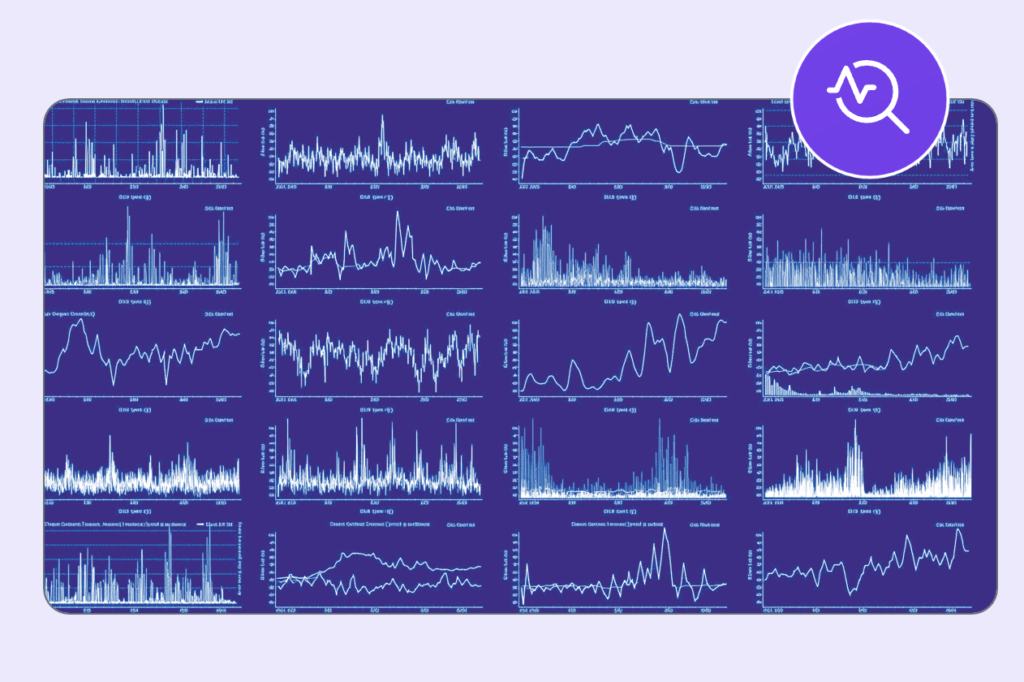
Instead of relying on predefined thresholds or rules, Anomaly Detector identifies deviations as they emerge — unexpected cost spikes, sudden drops in sales, or unusual operational behaviour. This makes it particularly valuable for scenarios where risks and opportunities cannot be fully anticipated in advance. Because the model adapts over time, it remains effective even as business conditions evolve.
Beyond time: spatial and relational context
Real-Time Intelligence extends analysis beyond the time dimension. New map-based applications enable organisations to combine real-time and historical data with spatial context. In logistics, for example, this allows teams to compare current routes with historical patterns and immediately detect anomalies or delays.

Fabric also introduces graph analytics through the Graph component. This enables modelling complex relationships between systems, assets, users and processes — relationships that are difficult or impossible to represent in traditional relational databases. Together, spatial and graph analytics provide deeper insight into cause-and-effect relationships across operations.
Digital Twin Builder adds another layer of context by allowing organisations to model physical assets, systems and processes as digital twins. By combining time-based, spatial and relational data, teams can simulate scenarios and understand the potential impact of events before they occur in the real world. This capability is especially relevant for manufacturing, logistics and other complex operational environments where understanding dependencies is critical.
AI, Copilot and agent-driven decision-making
Real-Time Intelligence is tightly integrated with AI capabilities across Microsoft Fabric. Copilot enables users to explore data, ask questions and generate insights using natural language, lowering the barrier between business users and complex analytics.

Beyond assisted analysis, Fabric introduces agent-based AI. These agents can operate autonomously within defined boundaries, monitoring real-time signals and taking action when conditions are met. Examples include adjusting prices, rerouting logistics or responding to operational disruptions.
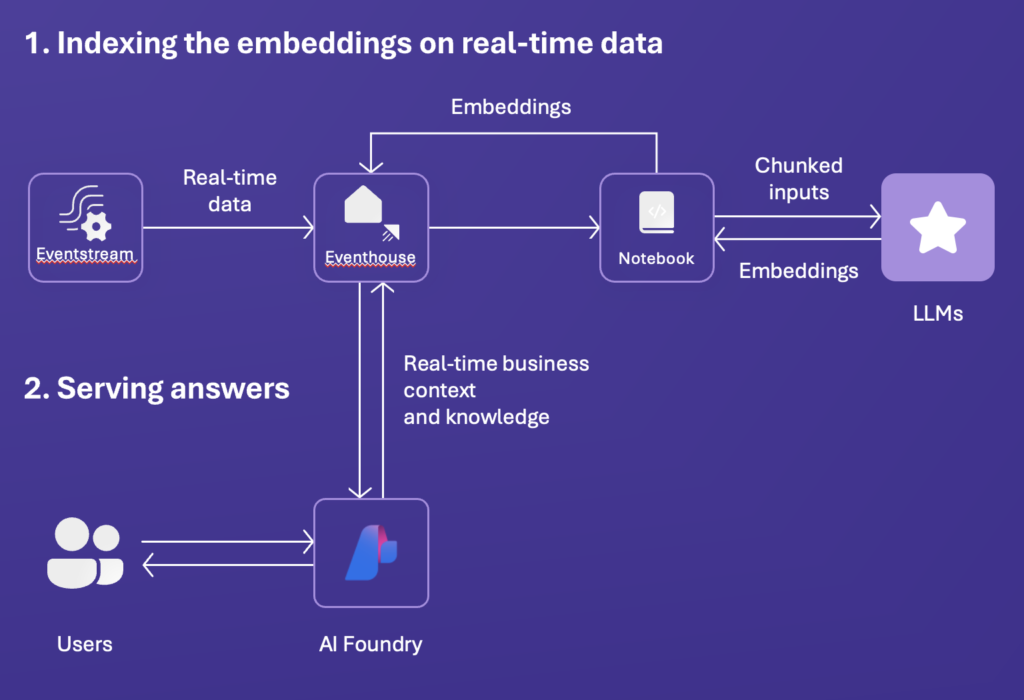
To ensure accuracy and relevance, Real-Time Intelligence supports Retrieval Augmented Generation. This allows Copilot and agents to ground responses in the organisation’s actual, up-to-date data rather than relying solely on a language model’s general knowledge.
From alerts to automated action
Closing the decision loop requires more than insight. Activator enables organisations to define rules that trigger actions when specific conditions occur. These actions can range from notifications to process execution or delegation to AI agents. This represents a shift from passive alerting to active, automated response — a critical step towards more autonomous, resilient operations.

Competing on reaction time
Markets move in days, hours and sometimes seconds. Competitive advantage no longer belongs to organisations that collect the most data, but to those that can turn signals into action the fastest.
Real-Time Intelligence in Microsoft Fabric enables organisations to operate at the pace of their data, reducing the gap between insight and impact — and turning real-time signals into real business outcomes.